

Manual link building is what most agencies and freelance SEOs do when providing backlinks to clients. The process is widely practiced by the SEO community and adheres to Google’s guidelines.
This blog explains the difference between automated and manual link building, thier pros and cons, how you can do manual link building for your business, and what tools are required to execute a manual link building campaign.
TL;DR
- Manual link building earns backlinks through human outreach, not software.
- It is safer and delivers higher-quality backlinks than automated link building.
- Digital PR, HARO, blogger outreach, niche edits, and listicles are the most effective strategies.
- Focus on relevance, editorial quality, and authority over DR alone.
- Personalize every outreach email and build relationships with editors.
- A few high-quality editorial backlinks outperform hundreds of low-quality links.
What is Manual Link Building?
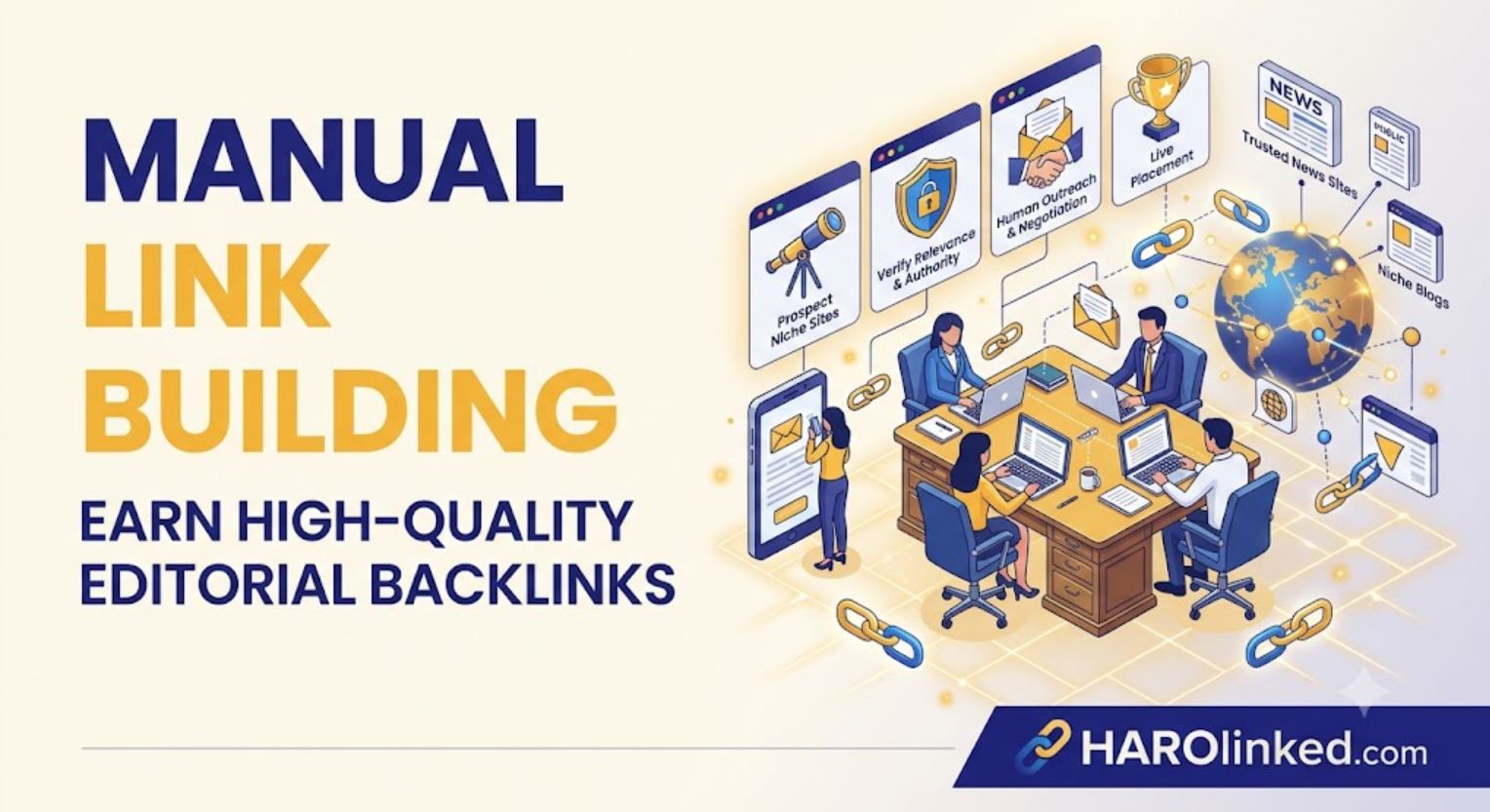
In simple words, the process of acquiring backlinks via manual outreach is called manual link building. The process generally involves four steps:
- Prospecting niche-relevant, high-authority websites
- Contacting them via email or contact form
- Negotiating a deal which includes content, links and anchor text
- Placement
Digital PR and Qwoted link building is also a type of manual link building, but the steps are slightly different. They include outreaching to journalists or answering journalists’ queries by providing expert opinion.
What are the Advantages of Manual Link Building?
There are many advantages of manual link building, such as the authority to select or reject websites that you find irrelevant to your business niche. Here are more advantages listed:
- Full Control Over Website Selection
- Niche-Relevant Backlinks
- Higher Editorial Standards
- Better Link Quality
- Lower Risk of Google Penalties
- Competitor-Based Link Building
- Stronger Brand Authority
- Higher Referral Traffic
- Long-Term SEO Results
- Improved Search Rankings
The biggest advantage of a manual link-building campaign is that it gives you the authority to choose the websites where you want your brand to be featured.
But before we discuss how to run a manual outreach link-building campaign and which link-building techniques it includes, let’s first clarify the difference between automatic and manual link building.
What is Automatic Link Building?
Automatic link building relies on software and scripts used to get backlinks from any website. This is a widely known black-hat SEO technique to rank higher on Google and can result in Google penalties.
The results are quick; you can make thousands of backlinks in a day or two and improve DR/DA in no time, but it is not a long-term solution with the risk of getting penalized by Google and other search engines.
Unlike manual link building, where we prospect niche-relevant websites, contact editors and webmasters, and secure a placement. Automatic link building relies on software getting very low-quality links from forums, profiles, blog comments, Web 2.0, etc.
Here are a few popular software programs for automatic link building:
| Software | Primary Use | Risk Level |
|---|---|---|
| GSA Search Engine Ranker (GSA SER) | Automatically builds backlinks on forums, blogs, wikis, directories, and Web 2.0 sites. | Very High |
| XRumer | Automates forum profile creation, registrations, and comment posting. | Very High |
| Money Robot | Creates backlinks across Web 2.0s, directories, social bookmarks, and blogs. | High |
| SENuke TNG | Automated backlink campaigns using multiple link sources. | High |
| RankerX | Builds tiered backlinks using Web 2.0 properties and articles. | High |
| Scrapebox | Primarily a scraping tool, but also automates blog commenting and URL harvesting. | High |
| SEO Autopilot | Automates backlink creation on various platforms. | High |
| FCS Networker | Creates and manages Web 2.0 networks with scheduled posting. | Medium–High |
| Ultimate Demon | Automates social bookmarking, directory, and profile submissions. | High |
| Magic Submitter | Bulk article submissions and account creation. | High |
I don’t recommend using any of these tools for your brand and businesses. However, these tools can be used if you want to build backlinks fast for an affiliate website, exact match domain, or rank a website quickly for an upcoming campaign.
There is a difference between automatic link building and automated outreach campaigns. Tools like Pitchbox, Respona, NinjaOutreach, etc, are great for contacting webmasters and editors on scale. These tools do provide backlinks and are 100% safe to use.
Still, we at HAROLinked don’t use any of these tools because we personalize every email in the outreach campaign. Automation isn’t inherently bad. Using software to find prospects, discover email addresses, or manage outreach is a standard and accepted SEO practice. The risk comes from tools that automatically generate backlinks at scale without editorial review.
Manual Link Building vs. Automatic Link Building
In manual link building, every step from prospecting to outreach and placement is handled by a person. Automated link building relies on software to create backlinks in bulk. Although manual link building is slower, it results in higher-quality backlinks, better control, and more sustainable SEO performance.
| Factor | Manual Link Building | Automated Link Building |
|---|---|---|
| Website Selection | Choose niche-relevant, high-quality websites | Links are created on whatever sites the software finds |
| Editorial Quality | Earn editorial backlinks from real websites | Mostly profile, forum, comment, or directory links |
| Relevance | Backlinks are highly relevant to your industry | Often placed on unrelated or low-quality websites |
| Quality Control | Reject spammy websites and link farms | Little or no quality control |
| Anchor Text | Natural and strategically diversified | Often repetitive and over-optimized |
| Competitor Targeting | Replicate and improve competitors’ backlink profiles | Cannot accurately target competitor opportunities |
| Brand Authority | Builds credibility through trusted publications | Provides little or no brand recognition |
| Referral Traffic | Can generate qualified visitors | Rarely sends meaningful traffic |
| Google Compliance | Aligns with Google’s quality guidelines | Higher risk of violating Google’s spam policies |
| Long-Term Value | Backlinks continue providing SEO value for years | Many links are ignored or lose value over time |
Does Manual Link Building Still Work for SEO and AI Search?
In a search marketing conference, Google’s Gary Illyes said that backlinks are not as important as many SEOs think. While I respect his opinion, my experience over the last five years has shown that high-quality backlinks still play an important role in competitive SEO.
Shortly after, Ahrefs analyzed one million Google search results to test that claim. Their conclusion was interesting. Links may be less influential than they were a decade ago, but they still show a meaningful correlation with rankings, particularly for competitive, local, and informational searches.
Search has changed a lot in 2026. Google AI Overviews, ChatGPT, Claude, and other AI search engines have made it easier than ever for businesses to create high-quality content. Almost every brand can now publish helpful articles at scale with the help of AI and a human editor.
So what separates one brand from another?
Authority.
Authority comes from the websites that mention and link to your business. When respected news websites, blogs, and industry publications reference your brand, it sends strong trust signals. This not only helps your SEO but also increases your brand’s credibility across the web.
I have worked on campaigns where the content was already excellent, but rankings didn’t improve until we started earning editorial backlinks from authoritative websites. Once those links went live, we saw noticeable improvements in rankings and organic traffic over the following months.
Can you rank without backlinks?
Yes, but usually only for low-competition keywords with little to no commercial value. If your goal is to rank for competitive keywords that drive leads and sales, high-authority backlinks are still one of the most important parts of a successful SEO strategy.
The goal isn’t to build hundreds of backlinks. It’s to earn a handful of relevant editorial backlinks from websites your audience and search engines already trust. In my experience, that strategy still works in 2026 and will continue to work as long as authority remains an important part of search.
Best Manual Link Building Strategies
Every aspect of manual link building requires human intervention, and nothing is automated. The outreach process can be automated with tools. Here are the best manual link building strategies and techniques you can use:
1- Digital PR
Digital PR is one of the most effective manual link building strategies for improving your brand authority, online visibility, and search rankings.
The process is straightforward, but it requires time, research, and persistence. It starts with creating a newsworthy, data-backed story that journalists actually want to cover. This could be based on original research, a survey, industry trends, or unique insights related to your business.
For one of our real estate clients, we created a research report on the ideal home size preferred by modern families in Los Angeles. We combined publicly available data with survey responses collected from the client’s existing customers to produce an original study.
Once the research was complete, we pitched our findings to journalists covering real estate, housing, and home improvement.
The campaign resulted in 16 editorial placements, earning high-quality backlinks from authoritative publications, including Money.com, Realtor.com, and Homes.com.
2- Journalist Outreach Platforms
Platforms like HARO, Featured, and Qwoted allow you to improve your brand authority and visibility by getting placements on top industry websites and magazines.
We got the same real estate client featured on GlobalBankingrates, Forbes Advisor, and DailyMail using Qwoted and HARO.
The process is simple; you have to sign up and create a profile. While HARO is free to pitch, Qwoted requires a paid subscription, available at $150/m.
You will have to find relevant journalist queries and share your expert opinion. If the journalist finds it worthy of including in thier blog, they will add it and link back to your website. It is a win-win situation for both; you get the link/placement, and they get your expert opinion.
The process is difficult and requires time, and responding quickly also matters. In our campaigns, pitches submitted within four hours have consistently produced the highest success rate.
At HAROlinked, we specialize in this type of manual link building. We have a dedicated team of writers who monitor all platforms for relevant questions from high-authority websites. However, if you have time, try it yourself.
3- Blogger Outreach and Niche Edits
Blogger outreach or guest posting is one of the oldest and most effective ways of manual link building. This is still practiced by SEO agencies and provides great results when done with care.
There are a few methods for this approach. You have to find super relevant and high-authority websites in your business niche. Reach out to the website owner or editor via email or contact form.
And see if they are interested in publishing an expert opinion piece from you. You are providing valuable content from your experience and expertise, and they are getting it for free. In return, ask them to link back to your website.
Usually this does not happen this way, because most webmasters and editors know the value of a dofollow link. They will either ask you to pay a small editorial fee or a three-way link exchange. Both of which are fine, because 90% of blogger outreach and guest posts are done this way.
You pay the price and done. You now have a backlink from a super relevant and high-authority website. However, you must be wondering how you will find the blogger websites and relevant magazines? Well, here is how to find them.
Similarly, niche edits or link insertion is done by adding your link to an already ranking article or page. This reduces the work on both sides, and you get a backlink from a page that is ranked and valued by Google. Plus, there are good chances you will get relevant leads from that link.
A) Competitor Link Analysis
You will need an Ahrefs or Semrush subscription to check the backlink profile of your competitors. Shortlist only healthy and relevant websites with high DR and organic traffic.
Download the shortlisted websites in a clean Google spreadsheet and start outreaching. Most of these sites will be more than happy to give you a backlink, because they have linked your competitors.
B) Using Google Search Operators
Google can be a great tool to find relevant websites for your manual link building campaign. Use these search operators to find donor websites.
- site:.com intitle:links “Fashion blogs”
- site:.fr inurl:resources “Fashion”
These search operators will give you good websites with decent authority and relevancy. Here is a complete guide on using Google to find backlinks.
C) Keywords
Typing industry-relevant long-tail keywords into Google and other search engines is one of the easiest ways to find backlink opportunities. The websites ranking for these keywords are usually niche-relevant and can be good prospects for guest posts or niche edits.
Here is the process I use:
For a client in the bridal dresses and accessories niche, I would search for keywords such as:
- best wedding dresses for summer weddings
- how to choose the perfect wedding dress
- bridal accessories for a beach wedding
- latest bridal fashion trends for 2026
- wedding dress shopping tips for first-time brides
You can create dozens of long-tail keyword variations to uncover more opportunities. As you go through the search results, you’ll find bloggers, affiliate websites, online magazines, brands, influencers, and other industry publications that could be suitable for guest posts, niche edits, or future outreach campaigns.
4. Broken Link Building
Broken link building involves finding dead links on relevant websites and suggesting your content as a replacement. Tools like Ahrefs or Semrush make it easy to identify broken outbound links and the pages linking to them.
The strategy works because you’re helping the webmaster fix a problem while providing a relevant replacement for their readers.
However, in my experience, the success rate is relatively low. Many webmasters either ignore outreach emails or replace the broken link with a page from a more established, authoritative website. That said, broken link building can still be worthwhile if you have high-quality content that closely matches the original resource.
5- Listicles
Listicles are one of the most popular manual link building strategies for earning editorial backlinks, increasing brand awareness, and improving your chances of being mentioned in AI search engines like ChatGPT, Claude, and Google AI Overviews.
After Google’s December 2025 Core Update, many SEO professionals questioned whether self-promotional listicles still worked. While some websites were negatively affected, high-quality listicles published on authoritative, relevant websites continue to perform well when they provide genuine value to readers.
A typical listicle looks like this:
Topic: 6 Best Bridal Dresses for First-Time Brides
- Introduction
- Your Brand
- Brand B
- Brand C
- Brand D
- Brand E
- Brand F
- Conclusion explaining why your brand stands out
When published on a trusted website, listicles can generate referral traffic, build brand authority, earn editorial backlinks, and increase your brand’s visibility in both traditional search results and AI-generated answers.
There is no single manual link-building strategy that works for every business. The most successful campaigns combine several of these methods to earn relevant, high-quality editorial backlinks that improve rankings, increase brand authority, and drive long-term organic growth.
Our Manual Link Building Process
Here’s the workflow we follow to earn high-quality editorial backlinks for our clients.
1- Evaluate Link Opportunities
Not every backlink is worth pursuing. Before reaching out, we evaluate each website using several quality signals, including:
- Organic traffic
- Topical relevance
- Domain Rating (DR) or Domain Authority (DA)
- Outbound-to-inbound link ratio
- Overall editorial quality
This helps us focus on websites that can provide long-term SEO value.
2- Find the Right Contact
The next step is identifying the person responsible for content or partnerships.
LinkedIn is one of the best places to find editors, content managers, and SEO managers. In our experience, LinkedIn messages often receive a higher response rate than cold emails.
If email is the preferred communication channel, tools like Hunter.io can help find verified email addresses.
3- Personalized Outreach
Every outreach email is written specifically for the website we’re contacting.
Whether we’re pitching a guest post, requesting a niche edit, or suggesting a listicle placement, we explain why our content is relevant to their audience instead of sending generic templates.
If we don’t receive a response, we follow up two or three times. Many successful placements come after the second follow-up.
4- Secure the Placement
Once a publisher agrees to collaborate, we provide everything they need to publish the backlink.
Depending on the campaign, this may include:
- A complete guest post
- The target URL and suggested anchor text
- Product information for a listicle
- Research and supporting data for Digital PR campaigns
Our goal is to make the publishing process as easy as possible for the editor.
5- Monitor Your Backlinks
Our work doesn’t stop once the backlink goes live.
We regularly monitor placements to ensure the links remain active and continue passing SEO value. Backlinks can disappear over time due to content updates, website redesigns, or page removals.
Monitoring also helps measure campaign performance and demonstrates the return on investment from your manual link-building efforts.
Tools We Use for Manual Link Building
Manual link building doesn’t require dozens of SEO tools. These are the tools we use regularly to research websites, manage outreach campaigns, and monitor backlinks.
- Ahrefs or Semrush – Competitor backlink analysis, backlink gap analysis, and website evaluation.
- Screaming Frog – Finding broken links and auditing websites.
- Hunter.io – Finding and verifying email addresses.
- BuzzStream – Managing outreach campaigns and tracking conversations.
- ChatGPT, Claude, and Gemini – Researching prospects, drafting outreach emails, and brainstorming campaign ideas.
Common Manual Link Building Mistakes
Over the years, I’ve seen businesses make the same mistakes repeatedly. Avoiding them can save you time, money, and disappointing results.
1- Chasing DR Instead of Quality
A high Domain Rating doesn’t always mean a website is valuable. Always look at topical relevance, organic traffic, and editorial quality instead of relying on a single metric.
2- Sending Generic Outreach Emails
Mass email templates rarely work. Personalizing your outreach significantly increases your chances of getting a response and building long-term relationships.
3- Building Links from Irrelevant Websites
A backlink should make sense for both readers and search engines. Links from unrelated websites rarely provide long-term SEO value.
4- Overusing Exact-Match Anchor Text
Using the same keyword repeatedly looks unnatural. A healthy backlink profile contains a mix of branded, generic, and partial-match anchor text.
5- Prioritizing Quantity Over Quality
One editorial backlink from a trusted publication is often worth more than dozens of low-quality backlinks from irrelevant websites.
Should You Build Links In-House or Hire an Agency?
Building backlinks in-house can work well if you already have an experienced outreach team and established publisher relationships.
However, building a team from scratch takes time. You’ll need to hire staff, invest in SEO tools, build outreach processes, and develop relationships with publishers before seeing consistent results.
A specialist link building agency already has those systems in place. That means you can start earning high-quality backlinks much sooner while your team focuses on growing the business.
Many companies use a hybrid approach by handling content creation internally while outsourcing manual link building to an experienced agency.
Final Thoughts
Manual link building remains one of the safest and most effective ways to earn editorial backlinks, strengthen your brand authority, and improve organic visibility.
The key is to focus on relevance, build genuine relationships, and prioritize quality over quantity. While the process takes time, the backlinks you earn are far more valuable than those generated through automated or spammy tactics.
If you’d like to outsource your manual link building, our team can handle everything from outreach and relationship building to securing high-quality editorial backlinks on authoritative websites.
Frequently Asked Questions
1. What is a manual link building service?
A manual link building service earns backlinks through human outreach instead of software. It includes finding relevant websites, contacting editors, securing placements, and monitoring live backlinks.
2. What is the difference between manual link building and manual outreach link building?
There is no real difference. Manual outreach link building simply emphasizes the outreach part of the process, where backlinks are earned by personally contacting website owners, editors, and journalists.
3. Are manual link building services worth it?
Yes, if you value quality over quantity. A good agency already has the tools, processes, and relationships needed to earn high-quality backlinks while saving you time.
4. How much does a manual link building service cost?
Pricing depends on the strategy and the quality of the websites. Guest posts usually cost less than Digital PR or journalist outreach because the latter requires significantly more research and effort.
5. What are the alternatives to manual link building?
The main alternative is automated link building. It’s faster but often produces low-quality backlinks with a much higher risk of Google penalties. Manual link building is slower but delivers stronger, long-term results.