

International link building is somewhat similar to what you do in regular link building. The outreach process, prospecting, and placement process are similar, but finding relevant websites with content in another language is a great challenge.
I know you have a great SEO team who can do whatever you throw at them, but international SEO link building is difficult and requires a highly experienced team to do things the right way.
International links become necessary for businesses when they are operating in different countries/ continents. Their competitors are actively acquiring backlinks from websites in different languages like Spanish, German, French, etc.
I will discuss the best strategies for international link building, which you can use to get high-authority editorial backlinks for foreign websites.
TL;DR
International Link Building Checklist
- Localize your website
- Add hreflang
- Pick one country first
- Analyze competitors
- Build country-relevant backlinks
- Track rankings
What is International Link Building?
International link building is the process of earning backlinks from relevant and high-authority websites in different countries, regions, and languages. These links signal search engines and LLMs about the relevancy of your brand outside your country and language.
Traditional vs. International Link Building
Although the core objective is the same, earning high-quality backlinks to improve search visibility, international link building requires additional planning, localization, and market research.
| Traditional Link Building | International Link Building |
|---|---|
| One language | Multiple languages |
| One target market | Multiple countries or regions |
| Standard outreach emails | Localized outreach in the native language |
| Domestic publishers | Country-specific publishers and media |
| Easier prospecting | More research and localization required |
Do You Need International Link Building?
International link building should come after traditional link building. It only makes sense once you have established a strong online presence in your home country and are ready to expand into international markets. It is also a smart strategy if fierce competition in your domestic market is limiting growth and you’re looking to attract customers from other countries.
Let me tell you this is not for every business. Service providers like law firms, plumbers, and dentists in the US or UK won’t need a backlink from a local Spanish website. Instead, they will benefit more from local link building services, because their target market is tied to a specific location and they can not sell their services internationally.
However, businesses like ecommerce stores, SaaS, payment services, etc should target international markets to improve global online visibility. For example, one of our previous clients, a VPN brand, translated their website into seven different languages and started internal SEO link building to attract more customers.
So when does international link building make sense?
- When you have a localized version of your website
- You want to gain new customers in a different country
- You have low organic traffic despite translating your site into the local language
- Your competitors are building country/language specific backlinks
- You are facing fierce ranking competition at home and want to establish your brand in other regions
If you are in any of the above-mentioned situations, international link building is for you. However, before moving forward with it, let me tell you how to prepare your website for it.
Preparing Your Website for International Link Building
Before launching your international SEO link building campaign, make sure your website is properly configured for each target country and language. This includes creating dedicated language or regional versions of your pages and implementing hreflang tags. These tags tell Google that the pages are equivalents in different languages or regions, helping it serve the correct version to users in each country.
Proper hreflang implementation helps Google understand which language or regional page to show users, reducing the risk of duplicate content issues and ensuring the correct version appears in search results. Although setting this up usually requires a developer, it’s considered an international SEO best practice.
If your website runs on WordPress, plugins like WPML can simplify multilingual page management and hreflang implementation.
Finally, avoid relying solely on AI or machine translations. For the best user experience and search performance, have your content written or reviewed by a native speaker who understands the language, culture, and local search intent.
Before launching your international link building campaign, make sure you’ve completed the following:
- Choose Your Target Countries and Languages
- Create Dedicated Language or Regional Pages
- Implement Hreflang Tags
- Use the Right URL Structure
- Localize Your Content (Don’t Just Translate It)
- Ensure Every International Page Is Indexable
Once your website is technically ready, you can start building high-quality backlinks from websites in your target countries to strengthen your international SEO efforts.
Benefits of International SEO Link Building?
International SEO link building helps your business expand beyond its home market by increasing your visibility in new countries and languages. Earning backlinks from locally relevant websites strengthens your international SEO, builds trust with search engines and users, and helps you attract qualified traffic from your target markets. Here are some of the key benefits:
- Improve Local Search Rankings – Backlinks from country-specific websites help search engines understand your regional relevance, making it easier to rank for local searches.
- Reach New International Customers – Get your business in front of people searching for your products or services in their own country and language.
- Increase Conversions – Visitors arriving from trusted local websites are more likely to engage with your brand and become customers.
- Diversify Your Traffic Sources – Reduce your reliance on a single market by attracting organic traffic from multiple countries.
- Strengthen Your Global Brand Presence – Build relationships with local publishers, news websites, and bloggers to increase your brand’s visibility and credibility in new markets.
Now your website is ready for international link building, and you know exactly what you will gain from it. Let’s discuss things you need to know before you start international SEO link building.
Planning Your International Link Building Campaign
Successful international link building starts long before the first outreach email is sent. You need to identify the right markets, understand local search behavior, analyze your competitors, and decide which pages deserve backlinks. A well-planned strategy ensures every backlink contributes to higher rankings and meaningful business growth.
You can do this yourself or hire an international link-building agency for assistance. We provide premium international and multilingual link-building services. And the best part is that you will have the authority to decide the websites and pay after the placement is live.
Moving forward, here are factors you should decide before starting:
1- Target Markets
I recommend my clients target one or two countries if they are going international. Targeting all will require more work and yield fewer results than targeting one or two countries or languages.
Focus on countries with the greatest opportunities. I remember we started with France with the VPN client after analyzing the market, buyers, and competition. After six months, we expanded our international link-building campaign to Germany and Spain.
But we didn’t select France on a leap of faith. We analyzed Google Analytics’ data for the last year. Checked which non-English-speaking country had the highest conversion rate and then decided to start with France, keeping Germany and Spain in the pipeline.
2- Analyze Competitors’ Backlinks
After you have decided the country, it’s time to find what your competitors are doing here. You can use tools like Ahrefs and Semrush to analyze competitor backlinks in a specific region.
How to do it? Most multilingual websites have a separate subfolder or subdomain for another language. You should only check the links made for that URL and URLs in that subfolder or subdomain.
For example:
We used NordVPN’s French subfolder to analyze their backlinks (https://nordvpn.com/fr) and found several great opportunities. We also checked the backlinks of ExpressVPN’s French subfolder (https://www.expressvpn.com/fr).
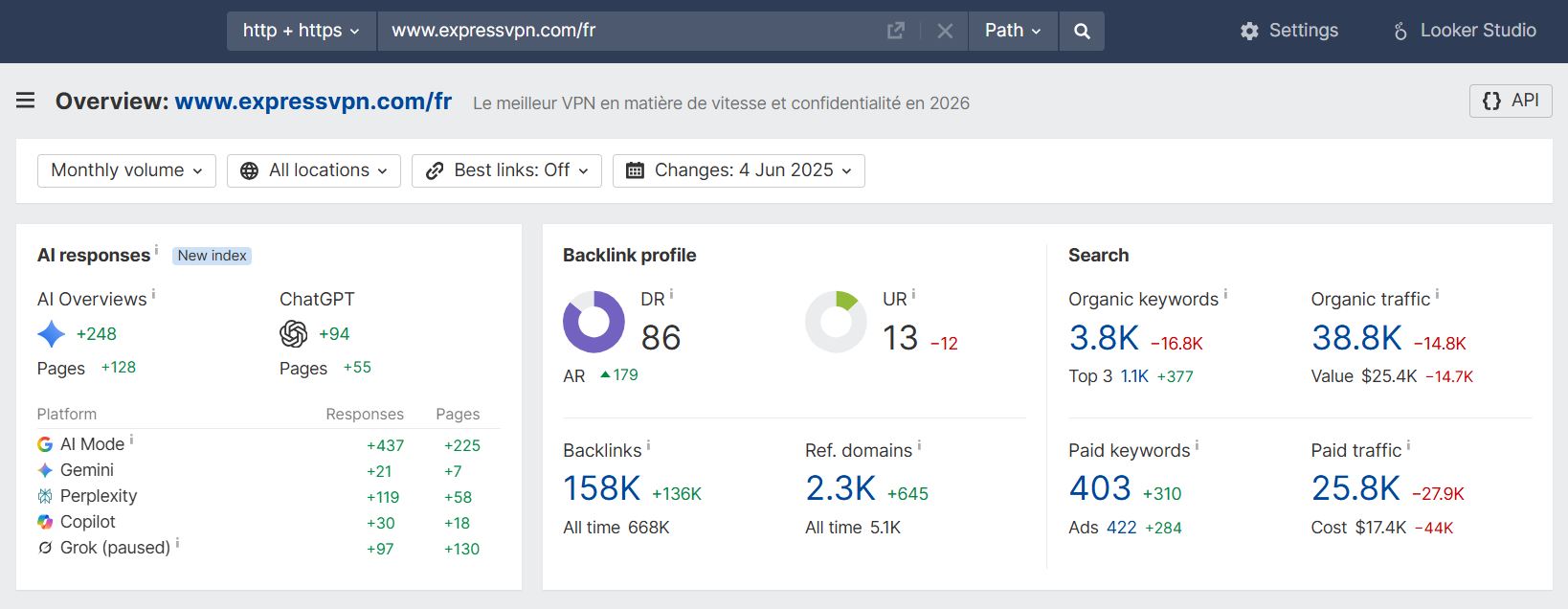 Here you can see that the French version of ExpressVPN’s website has 2300 referring domains. The next step is checking the exact website link to them by sorting them by domain rating and traffic.
After analyzing their link profile, we found that the French version of ExpressVPN has 90% backlinks from French websites; the remaining 10% are from websites in English. Moreover, the backlinks are coming from a variety of websites.
We are seeing backlinks from cybersecurity websites, movie websites, affiliate websites, bloggers, software websites, SaaS, etc. The average DR is around 50, and organic traffic is 15K per month.
After analyzing the backlink profile, we shared a report with our VPN client. We had a short meeting discussing ExpressVPN’s link building strategy and agreed on contacting only French websites with a domain rating of 50 and monthly organic traffic of more than ten thousand.
We got a list of 243 domains out of 2300 and began outreaching. In two months, we were able to secure 73 placements, which improved our client’s online visibility in France and increased traffic from 50 to 1500 in three months.
You can replicate the same steps for your international link building campaign, but it will take a lot of time. Do you think these links were built by ExpressVPN’s team? Of course not!
Brands and businesses outsource link building to agencies to save time and headcount. You can contact our team to discuss your international SEO link building campaign for free. You will get a competitor link analysis of four websites and a link building strategy.
3- Local Search Engines
Although Google dominates most markets, it’s not the only search engine you should consider.
Countries such as China, South Korea, and parts of Eastern Europe rely heavily on search engines like Baidu, Naver, and Yandex. Each has different ranking factors and webmaster guidelines.
Before launching your campaign, understand which search engine dominates your target market and adapt your SEO and link building strategy accordingly.
4- Domain Structure of Donor Website
The domain structure of donor websites affects how search engines interpret your content and backlinks. While working with the VPN client, our top priority was to get links from websites with an FR TLD. While backlinks from a .com domain that is in the French language are valued the same, we wanted to get only the best links for our client’s French version.
Most businesses choose one of three options:
- Country-code domains (example.fr)
- Subdomains (fr.example.com)
- Subdirectories (example.com/fr/)
I recommend others to go with the domains with country code first, then choose websites with subdirectories and lastly with subdomains. Make sure your website supports proper herflang before moving forward with your international link building campaign.
5- Target Pages
Since I have already mentioned above, translate your pages into the respective language where you want to expand. We should only target pages that matter the most, like the top converting pages, sales pages, service pages, product pages, etc.
The anchor text should have a variety. For our VPN client, we targeted 5 sales pages with a variation of anchor texts. For their Chrome extension page, we used these anchor texts: “VPN pour Chrome”,”VPN pour l’extension Chrome”, “VPN pour Google Chrome”, “VPN pour Google Chrome”, etc.
I recommend hiring a native link builder for assistance with language and content writing if you are doing it on your own.
To pull this off, you will need an international link building service provider like HAROLinked. Or you will need to hire a French-speaking link builder, discuss your priorities, and get tools like Ahrefs to explore competitor backlinks.
How to Find More International Link Building Opportunities?
For those of you without an Ahrefs subscription, all hope is not lost. Yes, you can find a lot of relevant link building opportunities by checking your competitor’s backlink profile, or you can use Ahrefs’ link intersect to find websites linking to them and not you.
But there are other ways to find relevant link-building opportunities. You can use Google search operators to find French websites that are relevant to your niche.
1- Using Google Search Operators
We had a client with an e-commerce store. He wanted backlinks from native German websites that his competitors do not have. His philosophy was simple: to beat competitors, I have to get links they have and links they don’t.
So we gave him 70% of his competitors’ backlinks found via Ahrefs and used different Google search operators to find native, relevant websites to his ecommerce store. Here is what we did.
- site:.de intitle:links “fitness blogs”
- site:.fr inurl:resources “fitness”
This approach helped us prospect more than 100 relevant websites, out of which we secured 46 placements. We also use these search operators to find competitor backlinks that Ahrefs and Semrush failed to crawl. Here is the search query “site:.de ExpressVPN.com”.
You can easily find several websites which have mentioned or linked competitors. Here is a detailed guide on using Google to find backlinks.
2- Native Local Directories, Media Sites and Industry Blogs
The best international backlinks come from websites your target audience already trusts. Look for reputable local directories, niche blogs, and regional news sites that are relevant to your industry. These websites not only strengthen your local relevance but can also send qualified referral traffic.
Use Google search operators to discover opportunities that may not appear in traditional searches.
- site:.de intitle:directory “Jackets”
- site:.fr inurl:blog “contact”
- site:.it “avvocati directory”
Before reaching out, review the website’s topical relevance, organic traffic, and editorial quality. A niche website with an engaged local audience is often more valuable than a high-DR website with no regional relevance.
3- Brand Mentions
Finding websites that already mention your brand without linking to it is one of the easiest ways to earn international backlinks. Use tools like Ahrefs Brand Radar, Semrush, or Brand24 to identify these opportunities, then reach out with a personalised email requesting a link.
At the same time, build relationships with local bloggers, journalists, and industry influencers. A single collaboration can lead to guest posts, product reviews, interviews, and recurring editorial mentions, creating a sustainable source of high-quality backlinks instead of one-off placements.
How to Outreach Websites for International Link Building?
You have made a list of websites; now it is time to contact them and earn real editorial backlinks. Email is widely used as the official tool for business communication in most countries. Here are a few things you should consider before contacting webmasters:
1- Local Language
Every outreach email should be tailored and personalized. I recommend using the same writer you hire for website translation and not AI or Google Translate. A native writer knows where and how to use words, how to set the tone of the email, etc.
2- Using the Right Communication Channel
In most countries, email is the default business communication tool. However, in some Southeast Asian countries, they prefer communication via chat or WhatsApp. In the US, UK, and Europe, most websites can be contacted via email or their contact form.
3- Tools to Use
30% of websites display email addresses on the contact page. While others can be contacted via a contact form. We use Hunter.io to scrape email addresses to contact webmasters and the advertising department. Email addresses can also be found on their social pages like Facebook and YouTube.
You can also use Pitchbox or BuzzStream to scale the outreach process. But I would recommend contacting every website with a personalized email.
4- Social Media
Keep an eye on local bloggers and influencers via Facebook, YouTube, and Instagram. They are some of the best prospects to contact with a 100% possibility of backlinks. And the quality of their website is often good because they are doing what they love.
For example, we contacted more than 70 French YouTubers in the cybersecurity, gaming, streaming, and privacy segment. We didn’t want them to create a video for our VPN client, but we wanted them to write a guest blog post on their websites recommending us as the best VPN brand.
They happily agreed, with a nominal fee. And we secured 55 dofollow backlinks through influencer and blogger outreach campaigns.
International Link Building Challenges and Solutions
International SEO link building is not as easy as traditional link building. There is a difference in language, culture, policies, etc.
Some countries have very limited good opportunities, while others offer low-quality websites. Here are a few challenges you may face and their solutions.
1- Finding Native Outreach and Content Experts
Successful international link building depends on working with people who understand the local language, culture, and communication style. While hiring experienced outreach specialists is straightforward in markets like the US or UK, finding reliable talent in smaller or less mature SEO markets can be much more challenging.
Solution: If building an in-house team isn’t practical, partner with local freelancers, consultants, or international link building agencies that already have relationships and experience in your target market.
2- Limited Local Link Building Opportunities
Not every country has the same number of high-quality websites willing to publish guest posts or editorial content. Some regions have fewer trusted publishers, making traditional outreach more competitive and time-consuming.
Solution: Expand your strategy beyond guest posting by targeting local news websites, industry associations, business directories, niche communities, digital PR campaigns, and influencer collaborations.
3- Navigating Local Laws and Search Engine Guidelines
Every country has its own regulations, advertising standards, and digital ecosystem. In some regions, paid links may create legal or compliance issues, while others rely on search engines that follow different ranking signals than Google.
Solution: Research local regulations, publisher policies, and search engine guidelines before launching your campaign. A compliant strategy protects your brand and ensures your backlinks deliver long-term value.
Common Mistakes to Avoid
Even the best international link building strategy can fail if it’s built on poor practices. Avoid these common mistakes to protect your rankings and get the most value from your backlink campaign.
1- Buying Low-Quality Backlinks
Cheap backlinks from link farms, automated networks, spammy directories, or forum profiles may look attractive, but they rarely provide long-term SEO value. In many cases, these backlinks result in negatively affecting your website’s health and overall online visibility and can invite a silent Google penalty.
There are a lot of freelancers who are selling forum links, blog commenting links, and other kinds of backlinks on Fiverr and Upwork. I would recommend avoiding them at all costs. Yes, their cost per link is dirt cheap, but these are useless links.
Best practice: Focus on earning editorial backlinks and media placements from relevant, trustworthy websites instead of chasing large numbers of low-quality links.
Ignoring Local Language and Culture
A backlink is only valuable if it comes from a website that serves your target audience. Simply getting a link from the right country isn’t enough. The language, regional focus, and content should also match your target market.
Best practice: Build backlinks from websites that are relevant to both the country and the audience you want to reach.
Prioritizing Quantity Over Relevance
Not every backlink helps your international SEO. A handful of links from reputable local publications will usually outperform dozens of links from unrelated websites.
Best practice: Prioritize websites that are topically relevant, locally trusted, and capable of sending qualified referral traffic, not just websites with a high Domain Rating.
Using the Same Strategy for Every Country
Every market has different publishers, search behaviour, and outreach expectations. A strategy that works in the United States may perform poorly in Germany, Japan, or Brazil.
Best practice: Adapt your outreach, content, and prospecting strategy to each country’s language, culture, and digital landscape.
Measure, Optimize, and Scale Your International Link Building
International link building isn’t a one-time campaign. The best results come from continuously monitoring performance, refining your strategy, and strengthening relationships with publishers in your target markets.
Track how your backlinks impact rankings, traffic, and conversions. If certain countries or pages outperform others, invest more resources there. Likewise, identify markets where your campaign isn’t delivering results and adjust your outreach, content, or target websites.
Monitor these key metrics:
- Growth in referring domains by country
- Organic traffic from target markets
- Keyword rankings by country and language
- Referral traffic from international backlinks
- Outreach response and placement rates
As your campaign grows, automate repetitive tasks like prospect research and reporting, but keep outreach personalised. Building genuine relationships with editors, journalists, and bloggers leads to better placements and long-term opportunities.
Final Words
International link building is a long-term investment that helps your business grow beyond its home market. By targeting the right countries, earning backlinks from trusted local websites, and adapting your strategy to each region, you can improve rankings, attract qualified traffic, and build a stronger global brand.
Ready to expand into new international markets?
Our international link building specialists can help you earn editorial backlinks from trusted websites in your target countries. With our pay-after-placement model, you only pay after your links are live.
Frequently Asked Questions
1- What is international link building?
International link building is the process of earning backlinks from websites in different countries and languages to improve your visibility in international search results.
2- Why is international link building important?
It helps search engines understand your relevance in target markets, improves local rankings, and attracts qualified traffic from different countries.
3- When should I start international link building?
Start once your website has localized pages, proper hreflang implementation, and you’re ready to target customers in other countries.
4- What is the difference between international and multilingual link building?
International link building targets websites in specific countries, while multilingual link building focuses on earning backlinks in different languages. Most global SEO campaigns use both.
5- How do I find international backlink opportunities?
Use competitor backlink analysis, Google search operators, local directories, industry blogs, media websites, and unlinked brand mentions to discover relevant opportunities. Check this guide for more details on getting good backlinks.
6- How long does international link building take?
Most campaigns begin showing SEO improvements within 3–6 months, depending on your competition, website authority, and the quality of backlinks earned. Here are more details on the number of links you need to rank your website.
7- Should I hire an international link building agency?
If you’re targeting multiple countries or languages, an experienced agency can save time, avoid costly mistakes, and leverage existing relationships with international publishers.
8- Can I buy international backlinks?
Avoid buying cheap backlinks from link farms or automated services. Instead, invest in editorial placements and high-authority backlinks on relevant, high-quality websites.
9- Does domain extension matter for international backlinks?
Yes. Country-code domains (such as .fr or .de) can strengthen regional relevance, although high-quality local websites using .com domains are also valuable.
10- How do I measure the success of an international link building campaign?
Track referring domains by country, keyword rankings, organic traffic, referral traffic, and conversions from your target markets.
11- Should I use AI to translate outreach emails?
AI can help with drafting, but outreach should always be reviewed by a native speaker to ensure the language, tone, and cultural context are accurate.
12- Can social media help with international link building?
While social media links don’t directly improve rankings, they help promote localized content, build relationships with publishers, bloggers, niche influencers, and create opportunities to earn editorial backlinks.