

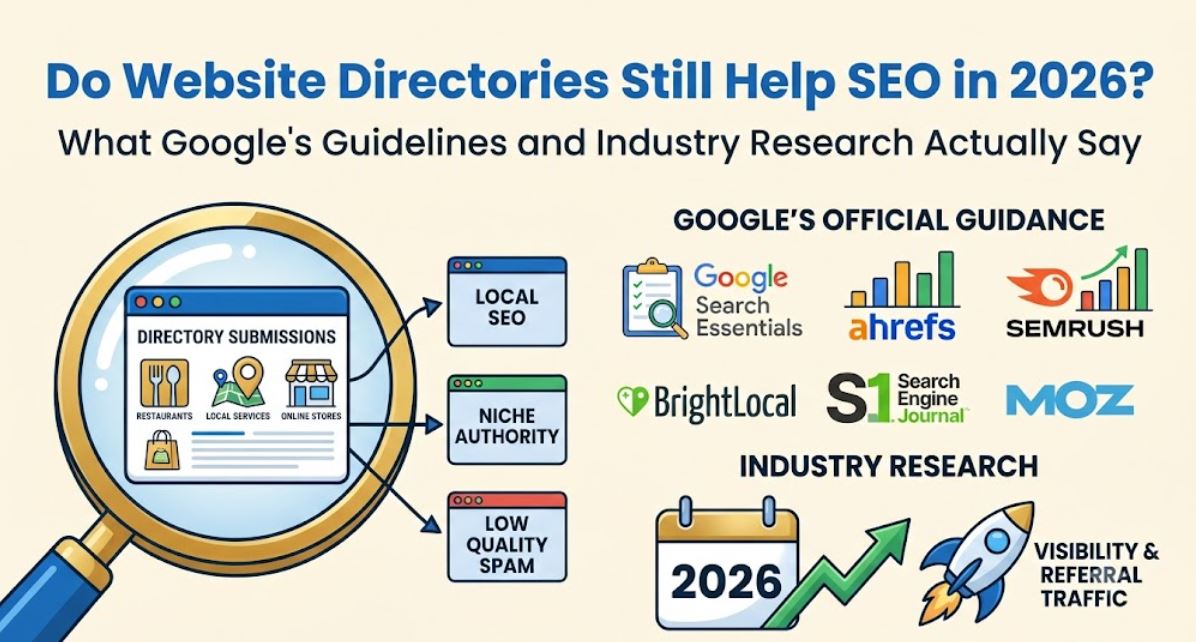
Website directories were once one of the most popular ways to build backlinks. Businesses would submit their websites to hundreds or even thousands of directories, hoping to improve their Google rankings.
That strategy worked—until it didn’t.
Today, Google has become much better at identifying manipulative link-building tactics, and most low-quality directories provide little to no SEO value. However, that doesn’t mean all directory links are worthless.
After reviewing Google’s documentation, SEO industry studies, and expert opinions, one thing is clear: the value of directory links depends entirely on the quality and purpose of the directory.
In this guide, we’ll examine what Google’s official guidance says, what industry research has found, and when directory links can still improve your SEO strategy.
The Rise and Fall of Website Directories
Before Google became the dominant search engine, website directories were one of the primary ways people discovered websites.
Some of the most popular directories included:
- Yahoo Directory
- DMOZ (Open Directory Project)
- BOTW (Best of the Web)
- JoeAnt
- Jasmine Directory
Website owners submitted their sites, editors reviewed them, and approved listings received backlinks.
As Google’s algorithm evolved and PageRank became more influential, marketers began abusing directories solely for link building. Thousands of low-quality directories appeared overnight, accepting every submission without editorial review.
This eventually led Google to crack down on manipulative directory links.
What Google Says About Directory Links
Google does not discourage directory links altogether.
Instead, Google warns against link schemes designed to manipulate rankings.
According to Google’s Search Essentials, excessive link exchanges, large-scale article marketing, and low-quality directory submissions intended primarily to influence rankings violate Google’s spam policies.
Google has also stated that directories providing genuine value to users, especially local business directories and niche industry directories, can still be useful.
The key distinction is intent.
A directory built to help users discover businesses differs greatly from a directory created only to sell backlinks.
What Industry Research Shows
Several leading SEO publications agree that directory links have changed rather than disappeared.
Ahrefs
Ahrefs recommends focusing on reputable, niche-relevant directories rather than mass submissions. Their research suggests that directory links alone rarely improve rankings, but authoritative directories can contribute to a natural backlink profile.
Semrush
Semrush identifies local business directories as an important ranking factor for local SEO. Consistent business information across trusted directories strengthens local search signals.
BrightLocal
BrightLocal’s Local Consumer Review Survey and Local Search Ranking Factors consistently highlight citations and directory listings as valuable for local businesses, particularly when combined with positive customer reviews.
Search Engine Journal
Search Engine Journal recommends avoiding spammy directories while continuing to use respected industry directories, associations, and local listings as part of a diversified link-building strategy.
Types of Website Directories
Not every directory is created equal.
1. Local Business Directories
Examples include Google Business Profile, Yelp, Bing Places, Apple Maps, and Yellow Pages.
These directories help search engines verify your business information and improve local visibility.
SEO Value: High for local businesses.
2. Industry Directories
These focus on specific industries such as legal, healthcare, SaaS, finance, construction, or marketing.
Examples include:
- Clutch
- GoodFirms
- G2
- Capterra
- DesignRush
Because they have editorial standards and real users, these directories often provide referral traffic alongside SEO benefits.
SEO Value: High.
3. Association Directories
Professional organizations, chambers of commerce, and trade associations often maintain member directories.
These listings usually come from trusted organizations and can strengthen a company’s credibility.
SEO Value: High.
4. Startup Directories
Platforms like Product Hunt, Crunchbase, and BetaList help new businesses gain visibility.
Although many links are nofollow, they can generate referral traffic, media attention, and brand mentions.
SEO Value: Moderate to High.
5. General Web Directories
Generic directories that accept every submission with little or no editorial review offer limited value today.
Many exist solely to sell backlinks.
SEO Value: Low.
When Directory Links Still Help SEO
Directory links continue to provide value when they:
- Come from trusted websites
- Have editorial review
- Generate referral traffic
- Are relevant to your industry
- Help users discover your business
- Verify your business information
These links contribute to a natural backlink profile rather than attempting to manipulate search rankings.
When Directory Links Can Hurt Your Website
Avoid directories that:
- Accept every submission instantly
- Exist only to sell backlinks
- Contain thousands of unrelated websites
- Have little or no organic traffic
- Are filled with spam or AI-generated content
- Promise guaranteed ranking improvements
Submitting your website to hundreds of low-quality directories is unlikely to improve rankings and may create an unnatural backlink profile.
How to Evaluate a Website Directory
Before submitting your website, ask yourself:
- Does the directory have real visitors?
- Is it indexed by Google?
- Does it have editorial guidelines?
- Is it relevant to my niche?
- Would I still want this listing if Google didn’t exist?
- Does it include accurate business information?
If the answer to most of these questions is yes, the directory is probably worth considering.
Directory Links vs Other Link Building Strategies
| Strategy | SEO Value | Referral Traffic | Difficulty |
|---|---|---|---|
| Local Directories | High (Local SEO) | Medium | Easy |
| Industry Directories | High | Medium | Medium |
| HARO & Digital PR | Very High | High | High |
| Guest Posting | High | Medium | Medium |
| Resource Pages | High | Medium | Medium |
| Editorial Mentions | Very High | High | Difficult |
Directory links work best as one component of a broader SEO strategy—not as a replacement for high-quality editorial backlinks.
Best Practices for Directory Link Building in 2026
- Focus on quality over quantity.
- Prioritize local and niche-specific directories.
- Keep your business information consistent across all listings.
- Avoid automated submission services.
- Review each directory before submitting.
- Monitor referral traffic from directory listings using analytics.
Final Verdict
Website directories are no longer the powerful ranking shortcut they once were.
However, reputable local directories, industry platforms, and association listings continue to provide real value through improved business visibility, referral traffic, and local SEO signals.
The biggest mistake businesses make is treating all directories the same. A listing on an authoritative industry directory can strengthen your online presence, while hundreds of low-quality directory submissions are unlikely to produce meaningful results.
Instead of chasing volume, focus on directories that users actually trust and use. When combined with content marketing, digital PR, and editorial backlinks, quality directory listings remain a useful part of a balanced SEO strategy in 2026.