

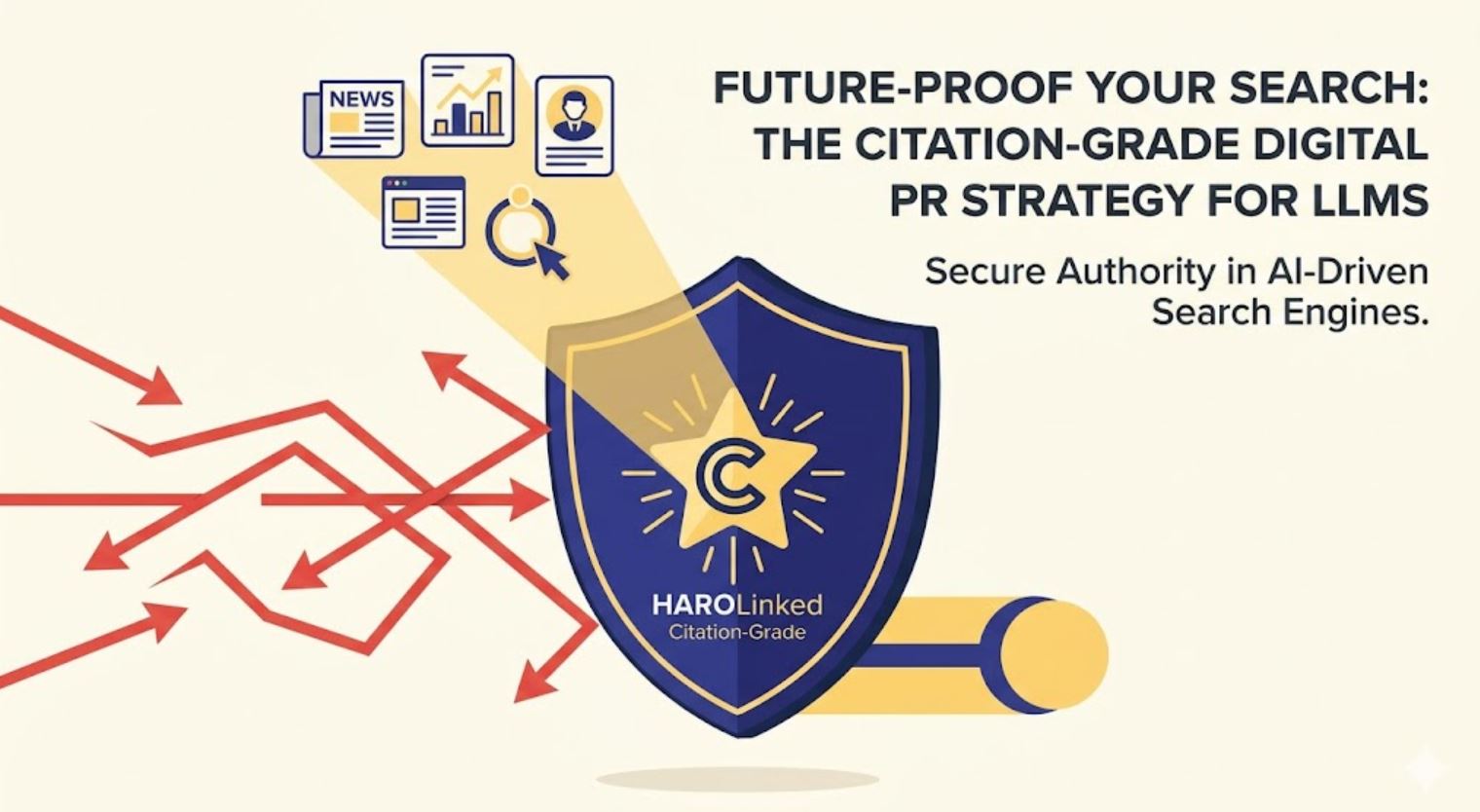
Why Citation-Grade Digital PR is the Ultimate LLM Strategy
For over a decade, traditional off-site link building has suffered from a profound reputation problem.
Ever since Google’s Matt Cutts famously declared guest blogging “done” back in 2014, the industry has been flooded by low-quality, automated outreach. Spammers took a legitimate practice, contributing expert insights to external publications, and reduced it to mass-blasted emails, outsourced content, and generic pitches designed solely to host a backlink.
The industry’s reputation never truly recovered. Now, a massive shift in the search landscape is putting the final squeeze on these old-school tactics.
On May 15, 2026, Google officially updated its search spam policies to clarify that attempts to manipulate its generative AI responses, including AI Overviews (AIO) and AI Mode, now fall under the exact same strict rules that govern traditional search.
According to industry reporting from Search Engine Land, the algorithmic targets are clear: biased self-promotional listicles, recommendation poisoning, scaled fake comparison content, and manufactured mention patterns designed to force a brand into AI answers.
  [ Old-School Link Building ]             [ Modern Digital PR ]
  • Automated, mass-blasted pitches        • Targeted, relationship-led outreach
  • Obscure blogs / "Link Farms"           • Premium news sites & publications
  • Content built solely as link bait      • Expert commentary & trusted insights
  • Highly vulnerable to AI algorithmic    • Built for both Google & LLM citation
    spam penalties
But where old-school SEO agencies see a threat, forward-thinking brands see an unprecedented opportunity. Optimizing for AI search engines (like Perplexity, ChatGPT, and Google Gemini) requires an entirely different playbook than traditional search engine optimization.
To win the future of search, brands must shift from traditional guest posting to Citation-Grade Digital PR. By leveraging advanced platforms like Qwoted and Connectively, you can earn authentic editorial mentions that satisfy both Google’s quality standards and the rigorous data requirements of Large Language Models.
The Core Mechanisms of AI Search: How LLMs Select Sources
To understand why traditional link-building methods fail in the AI era, you have to understand how a generative engine thinks.
Traditional Google search acts as a directional index; it matches keywords, weighs backlink profiles, judges page quality, and hands the user a list of blue links to interpret. If a brand’s market positioning is slightly muddy, a massive volume of traditional backlinks can still occasionally float a website to the top.
AI search engines have zero tolerance for muddy positioning.
LLMs do not just index data; they synthesize thousands of sources across the web, form a comprehensive view, and deliver a direct recommendation to the buyer. The AI system effectively forms an opinion. If your brand is left out of that synthesis, or if the model frames your product incorrectly, the buyer simply accepts the AI’s response and moves on.
The data backs this up. A comprehensive AI Search Benchmark Report by Ahrefs analyzed 75,000 brands across millions of generative AI responses to determine what drives visibility in engines like ChatGPT, Perplexity, and Google AI Overviews.
The findings were definitive: branded web mentions, whether linked or unlinked, showed the single highest correlation (0.664) with AI brand visibility. Traditional backlinks lagged far behind with a correlation of just 0.218. This nearly 3-to-1 gap reveals a structural reality about how LLMs learn: traditional search engines map navigation via links, but AI models read the full text of the web to establish market consensus on what to trust.
AI Visibility Correlation Factor (Ahrefs Study)
─────────────────────────────────────────────────────────
Standard Backlinks      █░░░░░░░░░ [Low-to-Medium Correlation]
Branded Web Mentions    ██████░░░░ [0.664 - 3x Stronger Correlation]
─────────────────────────────────────────────────────────
When Google clamped down on “manufactured mentions” in its May 2026 update, it didn’t say that brand mentions no longer matter. It signaled that spammy mentions are being aggressively devalued.
The models are trained to cross-reference data. If your brand is mentioned across high-authority, editorially vetted news sites, the LLM recognizes your business as a trusted entity. If your mentions only exist on obscure, pay-to-play blogs with a high Domain Rating (DR) but zero actual readership, the AI filters them out as background noise.
Anatomy of a “Citation-Grade” Placement
A citation-grade editorial placement is an off-site asset designed specifically to feed clean, authoritative data points to search crawlers and LLM training sets. To achieve this status, every quote, mention, and media placement must contain three foundational pillars:
1. Grounded Evidence and Hard Data
LLMs lean heavily on sources that provide concrete, non-generic data. When monitoring media requests on Qwoted or Connectively, your pitches must avoid high-level, generic authority statements. Instead, ground your commentary in original research, proprietary metrics, or distinct operational outcomes.
When you provide a journalist with an ultra-specific data point, two things happen: the journalist selects your quote for their article because it adds tangible value, and the LLM lifts that specific data point directly into its AI Overviews, citing your brand as the definitive source. The process is often referred to as Qwoted link building or digital PR links.
2. Radical Positioning Precision
When an LLM scans the web to understand your business, it looks for semantic consistency across four distinct vectors:
-
Product Category: What space do you operate in?
-
Ideal Customer Profile: Who exactly is your product or service built for?
-
Competitive Alternatives: What traditional software or manual process do you replace?
-
Unique Value Proposition: What specific mechanism makes you different?
If a guest article frames your company as an “all-in-one marketing platform,” but your homepage calls you a “B2B email automation tool,” the AI model’s understanding of your brand blurs. When a user asks an LLM for a recommendation, the model will always default to the competitor with the sharpest, most consistent digital footprint.
3. Direct Mapping to Intent Queries
AI engines retrieve answers by matching a user’s prompt to off-site content that answers that exact scenario. Rather than pitching generic topics, look directly at your internal Voice of Customer data, such as customer support tickets, sales call transcripts, and CRM notes.
Identifying the exact phrasing your buyers use to describe their problems allows you to reverse-engineer media pitches that map perfectly to long-tail AI search queries.
Qwoted vs. Traditional Guest Posting: The New ROI Metric
For years, digital marketers relied on traditional guest posting because volume metrics are easy to celebrate on a spreadsheet. A marketplace placement costs a few hundred dollars, goes live in two weeks, and checks a box on an SEO dashboard.
However, in high-competition spaces like B2B SaaS, enterprise finance, and specialized e-commerce, those numbers simply do not translate into organic revenue.
| Evaluation Feature | Qwoted & Connectively (Digital PR) | Traditional Guest Posting |
| Editorial Vetting | Extreme. Every quote is individually reviewed and approved by a real journalist. | Low-to-None. Content is frequently auto-published via paid agency networks. |
| Competitor Replicability | Impossible. Competitors cannot buy their way into an organic editorial feature. | High. Anyone with a credit card can secure a link on the exact same domain. |
| LLM Trust Weight | Elite. Placements land on top-tier news networks (Forbes, U.S. News, CNN). | Minimal. Placements are typically relegated to low-traffic “link farms.” |
| Pricing Transparency | Performance-Based. You only pay a flat fee upon successful live publication. | Fixed Upfront. You pay regardless of the real SEO value or placement quality. |
By executing a digital PR strategy focused on platforms like Qwoted, you secure a triple-threat ROI that traditional methods cannot replicate:
-
The Contextual Backlink: A highly natural, editorially placed link on a premium domain that passes immense traditional ranking equity to your site.
-
The Trusted Brand Mention: The foundational trust signal that drives your brand’s visibility inside generative AI engines.
-
The Referral Conversion Path: Real, high-intent readers clicking through from major publications to read your insights, driving qualified traffic and direct conversions.
Future-Proofing Your Authority Against Algorithmic Changes
Search algorithms will continue to evolve. Google will undoubtedly tighten its search spam policies again, and LLMs will refine how they pull, synthesize, and attribute their sources.
But if you build your brand’s off-site presence on genuine human expertise, precise market positioning, and real data, algorithmic updates cease to be a threat. By stepping away from automated, low-quality guest posts and adopting a high-fidelity, citation-grade digital PR strategy, you build a reliable, compounding competitive advantage that neither Google updates nor rival marketing budgets can displace.