

There was a time when getting featured in the media was something only large corporations could afford. Public relations agencies charged thousands of dollars every month, journalists relied heavily on personal relationships, and small businesses had little chance of being quoted in national publications.
That landscape has changed dramatically.
Today, a startup founder in Texas, an ecommerce business in London, or a local law firm in Sydney can all appear in respected publications without spending a fortune on advertising. Every day, journalists actively look for experts who can explain industry trends, share professional opinions, or provide data that strengthens their stories. If your business has genuine expertise, you already have something many reporters are looking for.
This process is known as journalist outreach, and it has become one of the most valuable marketing strategies available in 2026.
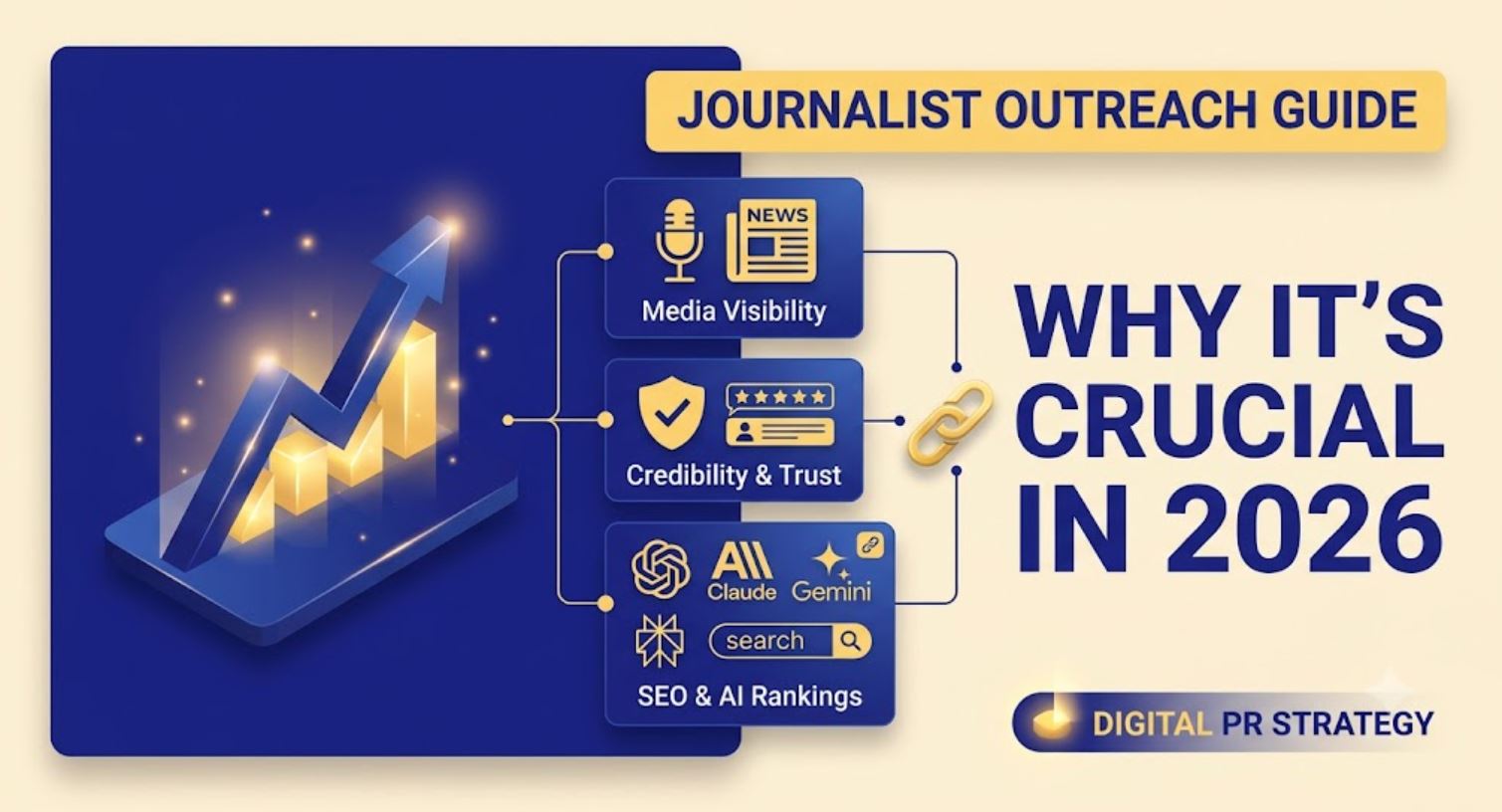
Unlike traditional advertising, journalist outreach doesn’t involve paying for attention. Instead, businesses earn media coverage by becoming useful sources for reporters. When successful, the rewards extend far beyond a single article. A media mention can strengthen your reputation, generate qualified traffic, improve your search rankings, attract new customers, and even increase the chances of your brand being referenced by AI search engines like ChatGPT, Claude, Gemini, and Perplexity.
That’s why journalist outreach now sits at the intersection of public relations, SEO, content marketing, and brand building. It’s no longer something reserved for Fortune 500 companies. Businesses of every size are investing in digital PR because editorial mentions consistently deliver value long after the original article is published.
In this guide, we’ll explore what journalist outreach actually is, why it matters more than ever, how professionals secure media coverage, the tools they rely on, and whether it’s something your business should start investing in.
What Is Journalist Outreach?
At its simplest, journalist outreach is the process of connecting with reporters, editors, producers, and writers to provide information that helps them publish better stories.
That information might come in many forms. A journalist could be looking for an expert opinion about interest rates, an interior designer’s thoughts on home renovation trends, a cybersecurity professional’s advice on password safety, or an entrepreneur willing to share lessons learned from building a company. Rather than interviewing someone at random, journalists actively search for qualified sources who can provide reliable, first-hand insights.
This is where businesses have an opportunity.
If you or someone within your company has genuine expertise, you can position yourself as that source. Instead of sending promotional emails asking reporters to write about your product, you contribute useful information that improves the quality of their article. In return, the journalist may quote your comments, mention your business, link to your website, or feature your company as an example.
The distinction is important because journalist outreach isn’t about convincing reporters to advertise your business. Good journalists aren’t interested in publishing marketing copy, and they quickly ignore pitches that feel overly promotional. What they need is information their readers will find valuable.
Imagine a journalist writing an article about rising home renovation costs. They might contact builders, architects, interior designers, and furniture manufacturers asking why prices have increased over the past year. If your response offers clear insights backed by experience, your quote may appear alongside nationally recognized brands. Readers discover your business because you helped explain an issue they care about—not because you purchased advertising space.
This difference is what makes journalist outreach so powerful. You’re earning attention instead of buying it.
Why Journalist Outreach Has Become More Important in 2026
Several years ago, most businesses viewed journalist outreach as something that belonged exclusively to the public relations department. Its primary purpose was generating publicity whenever a company launched a new product or announced a major partnership.
Today, the role of journalist outreach has expanded considerably.
Search engines have become much better at identifying authority. Rather than simply counting backlinks, Google increasingly evaluates the credibility of the websites linking to your business. A single editorial link from a trusted publication often carries more value than dozens of links from low-quality blogs or directories.
At the same time, online consumers have become more skeptical. Before purchasing a product or hiring a service provider, many people search Google to learn more about the business behind the website. Seeing your company quoted in respected publications immediately builds confidence. It tells potential customers that independent journalists considered your expertise credible enough to include in their reporting.
Artificial intelligence has accelerated this trend even further.
Large language models such as ChatGPT, Claude, Gemini, and Perplexity increasingly rely on authoritative sources when generating responses. Although their retrieval systems differ, they consistently favor information published by trusted organizations, established news outlets, and well-known industry websites. Businesses that regularly earn media mentions naturally build a stronger digital footprint, increasing the likelihood of being referenced when AI systems answer questions related to their expertise.
For this reason, journalist outreach is no longer just a branding exercise. It has become an investment in long-term online visibility.
Why Businesses Invest in Journalist Outreach
The immediate benefit of journalist outreach is obvious: your business appears in publications that potential customers already trust. But that’s only one piece of the puzzle. Companies continue investing in digital PR because the benefits compound over time, influencing everything from SEO performance to customer confidence and brand recognition.
One of the biggest advantages is credibility.
Imagine you’re comparing two accounting firms. Both have modern websites, competitive pricing, and positive client testimonials. However, one of them has also been quoted by Forbes, Business Insider, CNBC, and local financial newspapers over the past two years. Even if you’ve never worked with either company before, you’re naturally more likely to trust the one that independent journalists repeatedly use as an expert source.
That credibility influences purchasing decisions in ways advertising rarely can.
Journalist outreach also produces some of the highest-quality backlinks available. SEO professionals often describe editorial links as the gold standard because they’re earned rather than manufactured. When a journalist voluntarily references your website within an article, it sends a strong signal that your content deserves attention. Unlike paid guest posts or sponsored placements, editorial links exist because someone found your expertise valuable.
These links tend to come from websites with substantial authority, established editorial processes, and significant organic traffic. As a result, they frequently provide more SEO value than dozens of lower-quality backlinks acquired through traditional link-building methods.
Another benefit that businesses often underestimate is referral traffic. News websites, industry magazines, and popular blogs attract readers who are already interested in the topic being discussed. When your business is quoted within those articles, visitors arrive with a higher level of trust because they discovered you through a respected publication rather than an advertisement.
Journalist outreach also strengthens local visibility. While national publications receive most of the attention, regional newspapers, business journals, television stations, and community magazines remain influential within their local markets. A restaurant featured in its city’s newspaper, a real estate agent quoted in a regional property report, or a nonprofit highlighted by local television can experience a significant increase in recognition within the communities they serve.
Finally, journalist outreach contributes to what marketers now refer to as entity building. Search engines increasingly recognize businesses as entities rather than just websites. The more consistently your brand is associated with trustworthy publications, industry experts, and authoritative sources, the stronger your overall online presence becomes. That authority doesn’t disappear after one article—it continues to grow as additional publications reference your business over time.
How Journalist Outreach Works
If you’ve never run a journalist outreach campaign before, it’s easy to assume the process involves emailing hundreds of reporters and hoping someone replies. In reality, successful outreach is much more strategic than that. The businesses that consistently earn media coverage aren’t necessarily the biggest brands—they’re the ones that understand what journalists need and know how to provide it.
Every successful campaign begins with identifying a clear objective. Some companies are primarily interested in earning high-authority backlinks that improve their SEO performance. Others want to build credibility before launching a new product, while local businesses may simply want more exposure within their community. Defining the goal at the outset shapes every decision that follows, from the journalists you target to the type of stories you pitch.
Once your objective is clear, the next step is identifying relevant media opportunities. Many businesses make the mistake of treating every journalist as a potential contact. That approach rarely works. Journalists specialize in specific beats, whether that’s finance, healthcare, technology, travel, home improvement, or local news. A technology reporter isn’t likely to cover a restaurant opening, just as a lifestyle editor probably isn’t looking for commentary on cybersecurity.
Instead of building a huge contact list, experienced digital PR professionals spend time researching journalists who regularly write about their industry. Reading a reporter’s recent articles tells you a great deal about the kind of sources they prefer, the topics they cover, and the style of commentary they include. This research dramatically increases your chances of sending a pitch they’ll actually find useful.
After identifying the right journalists, the focus shifts to the story itself.
This is where many outreach campaigns fail.
Businesses often assume that journalists care about their company, their products, or their latest promotion. In reality, reporters care about whether a story will interest their readers. That’s an important distinction. A journalist isn’t looking for a sales pitch—they’re looking for information that makes their article stronger.
Imagine you’re the founder of an accounting firm. Instead of emailing reporters to announce that your company offers tax planning services, you could share insights about how changes to tax regulations are affecting small businesses this year. The second approach provides value first. If your comments help explain a complicated issue, the journalist has a reason to include your quote.
That’s why successful outreach almost always starts with expertise rather than promotion.
Timing also plays an important role. Newsrooms move quickly, and journalists often work against tight deadlines. A request for expert commentary posted at 9:00 a.m. may already have enough responses by lunchtime. Businesses that monitor media opportunities throughout the day and respond promptly consistently achieve better results than those checking requests once every few days.
Finally, journalist outreach doesn’t end when an article goes live.
One of the biggest advantages of digital PR is relationship building. If you’ve provided thoughtful, well-written insights that helped a reporter meet their deadline, they’ll remember you. Over time, many businesses become trusted sources that journalists contact directly whenever they need expert commentary. Those long-term relationships are often far more valuable than any single media placement.
What Makes a Journalist Choose One Expert Over Another?
This is the question every business should ask before writing its first pitch.
The average journalist receives dozens—sometimes hundreds—of responses for a single request. They’re not going to publish every quote they receive, which means they’re constantly evaluating which responses add the most value to their story.
Experience is one of the first things they look for. Journalists want to hear from people who actually work in the industry they’re writing about. A CEO explaining hiring challenges carries more weight than someone repeating advice they found online. Likewise, an interior designer discussing furniture trends is generally a stronger source than a freelance writer summarizing internet research.
Specificity also matters.
Compare these two responses:
“Businesses should invest in cybersecurity because cybercrime is increasing.”
Now compare that with:
“During the past twelve months, we’ve seen phishing attacks become far more sophisticated. One of our clients lost access to internal systems after an employee approved what appeared to be a routine Microsoft login request. Since then, we’ve introduced mandatory phishing simulations every quarter, reducing successful attacks by nearly 80%.”
The second response immediately feels more credible because it’s grounded in real experience. It gives the journalist something they can’t easily find elsewhere.
Originality is another major factor. Journalists spend their careers reading opinions. Generic advice rarely stands out, but a fresh perspective or an unexpected statistic often does. This doesn’t mean every pitch needs groundbreaking research. Sometimes sharing a simple observation from years of working with customers is enough to differentiate your response from everyone else’s.
Presentation matters as well.
Many business owners write far too much. They assume that longer responses demonstrate expertise, when the opposite is often true. Reporters appreciate concise answers that get to the point quickly. A clear, well-structured response is easier to quote than a thousand-word essay filled with unnecessary background information.
Perhaps the biggest factor, however, is reliability.
Journalists work under pressure. If they know someone consistently provides thoughtful, accurate responses before the deadline, they’ll return to that source repeatedly. That’s why many successful digital PR campaigns become easier over time. The first media placement is usually the hardest. After that, relationships begin to develop, making future opportunities much easier to secure.
The Different Types of Journalist Outreach
When people think about journalist outreach, they often picture a business emailing reporters directly. While direct pitching is still common, it’s only one part of a much larger ecosystem.
Today, businesses typically use four primary approaches.
The first involves responding to journalist requests through specialist platforms. These services connect reporters looking for expert commentary with professionals willing to contribute. Rather than trying to convince journalists to cover your business, you’re responding to stories they’re already writing. This is often the easiest entry point for companies new to digital PR because the demand already exists.
The second approach is proactive outreach. Instead of waiting for opportunities, businesses develop their own story ideas and pitch them directly to journalists. This works particularly well when announcing original research, product launches, company milestones, or industry reports. Because you’re creating the story rather than responding to one, proactive outreach requires stronger news judgment but can lead to much larger media coverage.
Reactive outreach is another increasingly popular strategy. Here, businesses monitor breaking news within their industry and quickly offer expert commentary while the topic is still developing. Speed becomes essential because journalists often need quotes within hours rather than days. Companies that can respond rapidly to emerging trends frequently become regular sources for news organizations.
Finally, many organizations invest in data-driven digital PR. This involves producing original surveys, market reports, or research studies that journalists naturally want to reference. Instead of pitching opinions, you’re pitching exclusive data. Original statistics consistently attract media attention because they provide journalists with something unique to build their story around.
The most successful digital PR campaigns rarely rely on just one of these methods. Instead, they combine reactive opportunities, proactive story ideas, and ongoing participation in journalist request platforms to create a steady stream of editorial coverage throughout the year.
Tools That Power Modern Journalist Outreach
Although relationships remain at the heart of journalist outreach, technology has made the process significantly more efficient. The right software won’t guarantee media coverage, but it can save countless hours and help teams identify opportunities they might otherwise miss.
Rather than relying on spreadsheets full of outdated contacts, most PR professionals now use dedicated media databases. Platforms such as Muck Rack, Cision, Prowly, and Roxhill allow users to search for journalists by industry, publication, location, and topic. Instead of guessing who covers cybersecurity or healthcare, businesses can quickly identify reporters who have written about those subjects recently.
For businesses that prefer responding to existing opportunities, journalist request platforms have become indispensable. Services such as Qwoted, Featured, Source of Sources (SOS), and Help a B2B Writer publish requests from journalists actively looking for expert sources. Because the reporter has already expressed interest in the topic, these opportunities often produce much higher response rates than cold outreach.
Email outreach software also plays an important role, particularly for agencies managing dozens of campaigns simultaneously. Platforms like BuzzStream, Pitchbox, Respona, and Mailshake help organize conversations, schedule follow-ups, and track replies without losing sight of personalization. While automation can improve efficiency, experienced PR professionals know that every successful pitch still feels like it was written specifically for the journalist receiving it.
SEO tools have become equally important throughout the process. Applications such as Ahrefs and Semrush allow businesses to evaluate the authority of publications, monitor newly acquired backlinks, and measure the long-term SEO impact of digital PR campaigns. Instead of simply celebrating a media mention, marketers can see how those editorial links contribute to organic search performance over time.
For larger brands, media monitoring tools complete the picture. Services like Google Alerts, Brand24, Mention, and Talkwalker notify businesses whenever they’re referenced online, making it easier to measure brand visibility and identify new relationship-building opportunities with journalists.
The technology has certainly evolved, but the underlying principle remains unchanged. These tools help you find journalists, organize outreach, and measure results. They don’t replace expertise, newsworthiness, or thoughtful communication. Those qualities still determine whether your pitch ends up in tomorrow’s headlines or tomorrow’s trash folder.